Roofing
What Is TPO Roofing? The South Florida Homeowner's Complete Guide
TPO roofing is one of the most popular flat-roof membranes in South Florida — but is it the right fit for your home? Here's everything you need to know before you buy.
Reviewed by Aldo Dellamano, Licensed General Contractor · Last updated April 2026
Introduction
f you own a flat-roof home, a commercial building, or a property with a low-slope addition in South Florida, you've almost certainly heard a contractor mention TPO. But when the estimate arrives and the abbreviation appears in the line items, most homeowners hit a wall — what exactly is TPO roofing, and why does everyone seem to recommend it? The answer matters more in Miami-Dade and Broward counties than anywhere else in the country.
South Florida's combination of relentless UV radiation, tropical downpours, salt-laden coastal air, and hurricane-force winds makes membrane selection a genuinely high-stakes decision. Get it right and your roof can perform quietly for 20-plus years. Get it wrong and you're calling a roofer after the first serious storm.
This guide breaks down everything — what TPO is made of, how it performs in our climate, what it costs, and how it stacks up against the alternatives.
Got questions about your roof or bathroom?
Get a free, no-pressure estimate from Haven's licensed Florida team.
Thermoplastic Polyolefin (TPO) roofing is a single-ply membrane system manufactured from a blend of polypropylene and ethylene-propylene rubber, reinforced with a polyester scrim, and heat-welded at the seams to create a watertight, monolithic surface — and in South Florida, it must carry a Miami-Dade Notice of Acceptance (NOA) to be legally installed in the High-Velocity Hurricane Zone (HVHZ), which covers all of Miami-Dade County and parts of Broward. That NOA requirement is not a formality. It means the membrane, adhesive, fastener pattern, and insulation assembly have been independently tested to meet the Florida Building Code's 175+ mph wind uplift standards — the strictest residential and commercial roofing code in the United States.
TPO was introduced to the U.S. market in the early 1990s as an alternative to the older PVC and EPDM membranes that dominated commercial roofing at the time. It rapidly gained market share because it combined PVC's heat-weldable seams (far more reliable than the glued or taped seams used on EPDM) with a lower price point and better UV resistance in hot climates. Today, TPO accounts for the largest share of the single-ply commercial roofing market in the United States, according to data tracked by the National Roofing Contractors Association (NRCA).
“Florida's average of 237 sunny days per year means roof surface temperatures on a dark membrane can exceed 170°F in July.”
For South Florida specifically, the white or light-gray reflective surface of a standard TPO membrane is a significant benefit. Florida's average of 237 sunny days per year means roof surface temperatures on a dark membrane can exceed 170°F in July. A white TPO membrane reflects 70-80% of solar radiation, keeping surface temps far lower and reducing cooling loads — a measurable win for energy bills in a market where air conditioning runs year-round. If you want to compare TPO directly with the other common flat-roof option, our detailed breakdown of what is EPDM roofing covers the rubber membrane alternative side by side.
In the Field
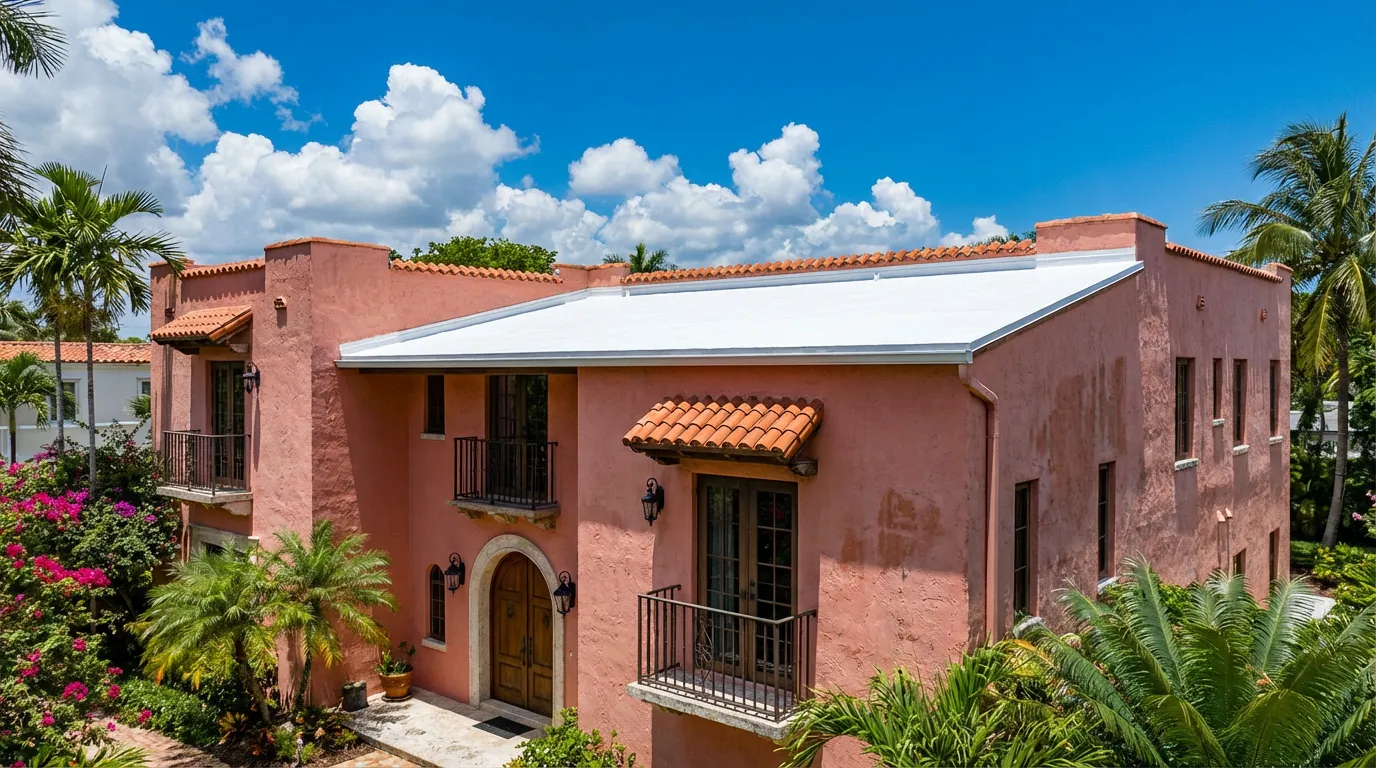
A white TPO membrane installation on a flat-roof home in Miami-Dade County — the reflective surface is a key energy-efficiency advantage in South Florida's intense sun.
A white TPO membrane installation on a flat-roof home in Miami-Dade County — the reflective surface is a key energy-efficiency advantage in South Florida's intense sun — Haven Bathrooms & Roofing, Miami, FL
Free Roofing Estimate
Ready to talk through your roof?
Tell us about your home and project. We'll get back to you within 24 hours with a free, no-obligation estimate from our licensed Florida roofing crew.
- Licensed & Insured FL Contractor
- Local crew, no subcontractors
- Free, no-obligation estimate
- We respond within 24 hours
4.9 / 5 from 500+ homeowners
Get Your Free Estimate
No obligation. We'll respond within 24 hours.
Common Questions
Frequently Asked Questions
From the Blog
Continue Reading
Roofing
What Is Modified Bitumen Roofing? A South Florida Homeowner's Complete Guide
Learn what modified bitumen roofing is, how it performs in South Florida's heat and hurricanes, and whether it's right for your flat or low-slope roof.
Read articleRoofing
How to Install Roll Roofing: A Complete South Florida Roofing Guide
Learn how to install roll roofing on South Florida homes — materials, step-by-step process, HVHZ code tips, and when to call a licensed pro instead.
Read articleRoofing
What Is the Best Roofing Material for South Florida Homes?
Tile, metal, or shingles? Discover what is the best roofing material for South Florida's heat, humidity, and hurricanes — with costs and lifespans.
Read article