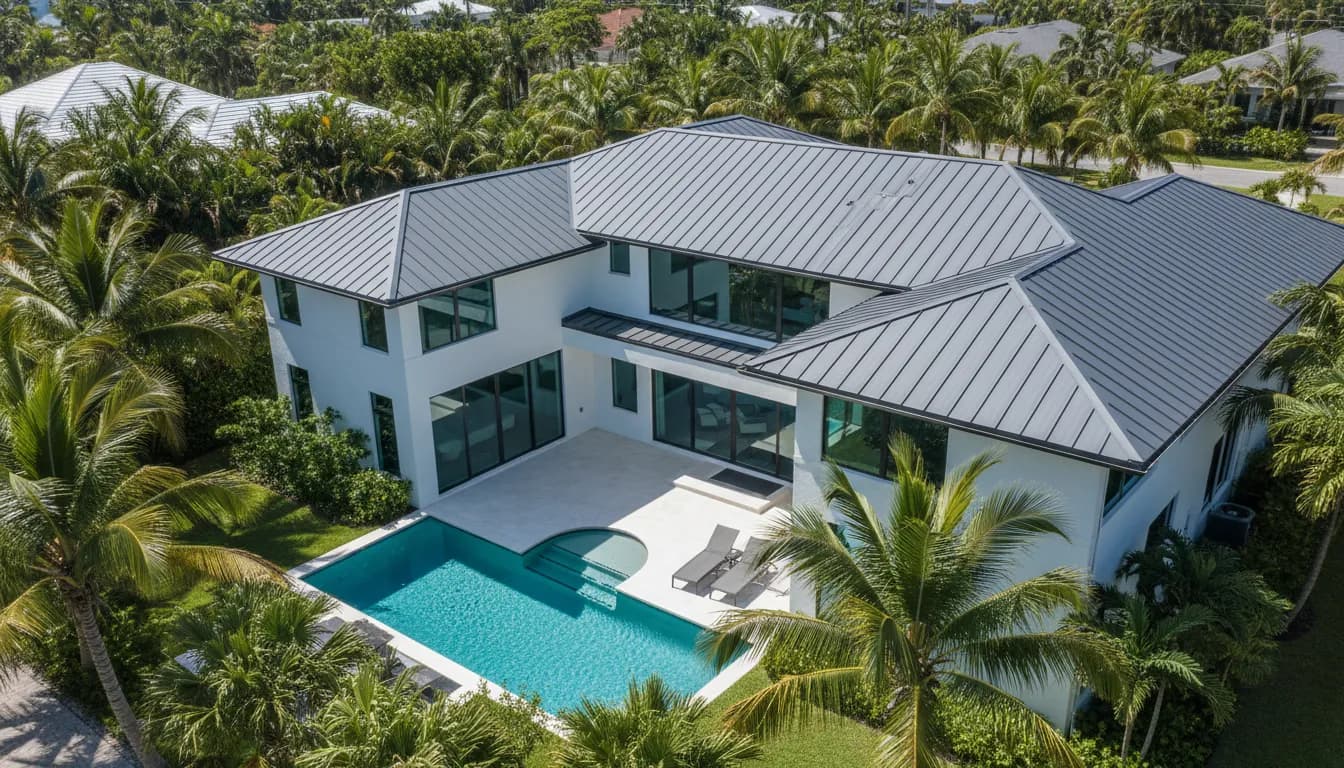
Roofing · Metal Roofing
Metal Roofing in South Florida: Standing Seam, Galvalume & Kynar-Coated Systems Built to Last
Standing seam and corrugated metal systems built to last 50+ years
4.9 / 5 from 500+ South Florida homeowners
Get Your Free Estimate
No obligation. We'll respond within 24 hours.
Reviewed by Aldo Dellamano, Licensed General Contractor · Last updated April 2026
Introduction
etal roofing is the long-game choice for South Florida homeowners. Where asphalt shingles average 15–20 years under subtropical heat and hurricane-force winds, a properly installed standing seam metal roof carries a 50-year-plus service life — and the engineering to back it up. Haven Bathrooms & Kitchens installs standing seam, corrugated, and exposed-fastener metal systems across Miami-Dade, Broward, Palm Beach, Martin, and St.
Lucie counties. Every project is permitted, inspected, and installed by one of our 20 in-house crews — no subcontractors, no day labor. General contractor Aldo Dellamano leads a team with over 30 years of South Florida construction experience, and we pull more than 1,500 building permits per year.
If you're comparing metal roofing contractors, this guide covers everything: panel profiles, coatings, wind ratings, code requirements, cost drivers, and what our installation process actually looks like.
Got questions about your roof or bathroom?
Get a free, no-pressure estimate from Haven's licensed Florida team.
Metal roofing in Miami-Dade and Broward counties must comply with the Florida Building Code's High-Velocity Hurricane Zone (HVHZ) provisions — among the strictest residential roofing standards in the United States — and every panel, fastener, and underlayment assembly must carry a Miami-Dade Notice of Acceptance (NOA) before it can be legally installed. That regulatory baseline is exactly why metal outperforms so many alternatives here: the same properties that earn panels their NOA — interlocking seams, tested pull-over resistance, thermal expansion accommodation — are the properties that make them durable decade after decade under Category 4 conditions.
After Hurricane Andrew in 1992, Hurricane Wilma in 2005, and Hurricane Irma in 2017, post-storm surveys consistently showed metal roofs sustaining less damage than competing systems at equivalent wind speeds. NOAA's National Hurricane Center data shows South Florida's Atlantic coastline averages a significant tropical storm or hurricane impact roughly every 8–10 years, making durability a financial argument as much as a comfort one. Homeowners in Miami Metal Roofing coverage areas, especially in older neighborhoods like Coconut Grove and Brickell, are increasingly replacing original barrel tile or aging shingles with standing seam metal for exactly this reason.
“If you're still weighing metal against other systems, our guides on Shingle Roofing and Tile Roof Replacement lay out the tradeoffs in the same level of detail.”
For a broader overview of all roofing systems we install, visit our Roofing hub. If you're still weighing metal against other systems, our guides on Shingle Roofing and Tile Roof Replacement lay out the tradeoffs in the same level of detail.
What You Get
Metal Roofing System Options We Install
Standing Seam (Concealed Fastener)
Vertical panels lock together at raised seams, hiding all fasteners from weather exposure. The gold standard for longevity and water resistance — ideal for low-slope applications down to 1:12 pitch with proper underlayment.
Corrugated & R-Panel (Exposed Fastener)
Lower installed cost than standing seam, well-suited for outbuildings, covered patios, and secondary structures. Neoprene-gasketed screws must be inspected and re-torqued after 10–15 years as gaskets degrade in UV exposure.
Galvalume Steel
An aluminum-zinc alloy coating over steel substrate that provides superior corrosion resistance compared to standard galvanized. G-90 galvanized is code-minimum in many jurisdictions; Galvalume AZ-50 is the preferred spec for coastal South Florida applications.
Aluminum Panels
Naturally corrosion-resistant and roughly 30% lighter than steel. The preferred substrate within one mile of saltwater — critical for waterfront properties in Miami Beach, Aventura, and Coral Gables. Does not rust, but dents more easily than steel.
Kynar 500 / PVDF Coatings
Polyvinylidene fluoride (PVDF) coatings marketed under brand names like Kynar 500 and Hylar 5000 offer the highest color stability and chalk resistance available. Florida's UV index routinely hits 11+ in summer; Kynar-coated panels retain gloss ratings well beyond 30 years where standard polyester coatings fail in 10–12.
Common Questions
Metal Roofing FAQs
Helpful Reads
Roofing Guides for South Florida
Roofing
What Is Modified Bitumen Roofing? A South Florida Homeowner's Complete Guide
Modified bitumen roofing is one of the most reliable flat and low-slope roofing systems for South Florida homes — but is it right for yours? Here's everything you need to know.
Read articleRoofing
How to Install Roll Roofing: A Complete South Florida Roofing Guide
Roll roofing is a fast, affordable option for low-slope roofs and outbuildings — but South Florida's HVHZ wind codes and relentless UV exposure change the installation rules significantly. Here's everything homeowners need to know.
Read articleRoofing
What Is the Best Roofing Material for South Florida Homes?
Not every roofing material survives South Florida's heat, salt air, and hurricane-force winds equally. This guide breaks down the top options so you can choose the right roof for your home and budget.
Read articleFree Estimate
Ready for Metal Roofing?
Get a free, no-obligation estimate for metal roofing. We serve Miami-Dade, Broward, Palm Beach, Martin, and St. Lucie counties.